What Is Motion in Physics? Types of Motion, Distance vs Displacement and Speed

The article is written by Pavlo Chaika, the chief editor of the "Piznavayka" magazine. Since its founding in 2013, Pavlo Chaika has been dedicated to popularizing science in the world. The main goal, both of the magazine and of this article, is to explain complex scientific topics in a simple and accessible language.

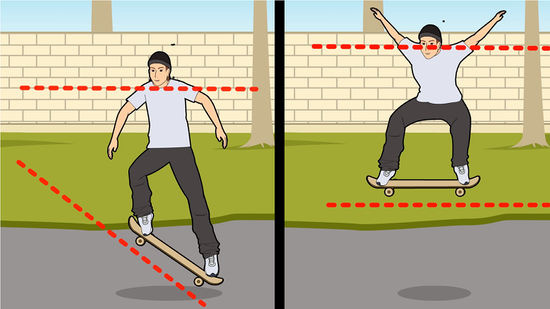
Picture this: you’re scrolling your feed and a skater pops an ollie over a bench. Sick, right? Now your inner physicist says: “Bro, that’s literally motion in physics.” And they’re not wrong.
Motion is one of the first big topics in grade 7 science. It looks easy, but it hides a few traps that trip up even adults. In this guide we’ll break it all down, no boring stuff: what motion is, why you need a reference point, the difference between distance and displacement, the main types of motion, and how to calculate speed. Let’s go!
What Is Motion in Physics? (Simple Definition)
Motion is a change in an object’s position relative to other objects over time.
That’s the textbook definition, so lock it in for your next test. You may also see it called mechanical motion.
Now in normal words: if something was “here” and a bit later it’s “over there”, it moved. That’s it. No magic.
The definition has three key parts:
- position changes — the object doesn’t stay put;
- relative to other objects — there’s always something you compare it to;
- over time — motion never happens instantly, it takes time.
The branch of physics that studies motion is called mechanics. The part of mechanics that describes how things move (where, how fast, along what path) is kinematics. Sounds fancy, but it’s basically “the physics of moving stuff”.
Reference Point and Frame of Reference: “Moving Compared to What?”
Imagine a text chat:
— where r u?
— by the school, omw to you
Your friend instantly gets where you are, because there’s a starting spot to measure from: the school. In physics this is called a reference point (or reference body).
A reference point is the object we use to describe the position and motion of other objects.
It can be a house, a tree, the Earth, a train car, or even you.
But one object isn’t enough. To fully describe motion, physicists build a combo of three things called a frame of reference:
- A reference point — what we measure from.
- A coordinate system — how we describe position (like “3 meters right and 2 meters forward”).
- A clock — something to measure time, like a stopwatch.
Think of a frame of reference as the GPS on your phone: a starting point, coordinates on a map, and time. Without it, you simply can’t describe motion.
Relative Motion: You’re Moving and Standing Still at the Same Time
This is where it gets mind-blowing. You’re sitting on a bus, scrolling TikTok. Question: are you moving or not?
The correct answer: both. It all depends on your reference point:
- compared to the driver and the seats, you’re at rest — the distance between you doesn’t change;
- compared to the bus stop, you’re moving — it’s getting left behind;
- compared to the Sun, you’re flying along with Earth at about 30 km per second. That’s OP, no cap.
Relative motion: the same object can be moving relative to some objects and at rest relative to others.
That’s why saying “it’s moving” without “relative to what” sounds a bit cringe to a physicist.
Relative Motion Examples from Everyday Life
- On an escalator, you’re still relative to the step but moving relative to the walls.
- A passenger on a plane calmly sips juice while flying over 500 mph (800+ km/h) relative to the ground.
- When the train next to yours starts moving, it feels like your train left. Your brain just picked the wrong reference point.
- Trees outside the car window seem to run backward, even though you’re the one moving.
Fun fact: Galileo Galilei explained this with a ship. If a ship sails smoothly at a steady speed, a person inside a closed cabin can’t tell by any experiment whether it’s moving.
Point Particle: When Size Doesn’t Matter
A train over 100 meters long travels from London to Edinburgh. Does its length matter when you calculate the travel time? Nope. The trip is about 400 miles (roughly 650 km), so the train’s length is tiny in comparison.
In cases like this, physicists use a life hack called a point particle (also called a point object or material point).
A point particle is an object whose size can be ignored in a specific problem.
We just imagine the whole thing shrunk down to a single dot. Heads up: the same object can be a point particle in one problem and not in another:
- Earth orbiting the Sun — a point particle (the distance is huge compared to Earth’s size);
- Earth when you’re looking up your city on a map — not a point particle;
- the train on the London — Edinburgh route — a point; the same train pulling into the platform — not.
Trajectory: The Path of Motion
A trajectory (or path of motion) is the line an object follows as it moves.
You can actually see it when the object leaves a trail:
- the white contrail of a plane in the sky;
- ski tracks in the snow;
- a sparkler’s glowing line in a long-exposure photo;
- bike tire marks on wet pavement.
Based on the shape of the trajectory, motion can be rectilinear (straight-line motion) or curvilinear (curved motion). More on that below.

Distance vs Displacement: What’s the Difference?
This is the topic where half the class gets lost. Let’s fix that once and for all.
You leave home, walk to the store, then walk back. The store is 300 meters away.
- Distance is the length of the path, so how much ground you actually covered. Here: 300 m there + 300 m back = 600 m. That’s what the step counter on your phone tracks.
- Displacement is a straight arrow from your starting position to your final position. You started at home and ended at home, so your displacement is 0 m. LOL, but it’s facts.
TL;DR: distance = “how much you walked”; displacement = “how far and in which direction you ended up from the start”.
| Distance | Displacement | |
|---|---|---|
| What it is | Length of the path traveled | Arrow from start to finish |
| Symbol | d (or s) | Δx or s with an arrow (a vector) |
| Has a direction? | No (scalar) | Yes (vector) |
| Can it be zero while moving? | No | Yes, if you return to the start |
| SI unit | meter (m) | meter (m) |
Pro tip: distance is never less than the size of displacement. They’re equal only when an object moves in a straight line without turning back.

On the left, distance is longer than displacement because the road loops around. On the right, you came back home, so distance is 600 m and displacement is zero.
Types of Motion (with Examples)
Motion comes in different types, kind of like game genres. Here’s how they’re grouped.
By the Shape of the Path
- Rectilinear (linear) motion — the object moves in a straight line. Example: a ball dropped straight down, or a sprinter in a 100 m race.
- Curvilinear motion — the path is curved. Example: a basketball arcing toward the hoop.
- Circular motion — a special type of curved motion along a circle. Example: a Ferris wheel cabin, the tip of a clock hand, fan blades.
By Speed: Uniform and Non-Uniform Motion
- Uniform motion — an object covers equal distances in equal intervals of time. Example: an escalator, or a car on the highway with cruise control on.
- Non-uniform motion — an object covers different distances in equal intervals of time. Example: you biking through the city, speeding up and braking at traffic lights. In real life, almost all motion is non-uniform.
When an object’s speed increases or decreases at a steady rate, it’s called uniformly accelerated motion. You’ll dive into it in later grades, so for now just remember the name.
By How the Object Moves
- Translational motion — every point of the object moves the same way. Example: an elevator, a drawer sliding out of a desk.
- Rotational motion — the object spins around an axis. Example: a fidget spinner, a wheel, Earth spinning on its axis.
- Oscillatory (periodic) motion — the object moves back and forth, repeating the same movement. Example: a swing, a pendulum, a guitar string.
Speed Formula: How to Calculate Speed
Two friends each run 100 meters. One does it in 12 seconds, the other in 20. Who’s faster is obvious. But how much faster? That’s what speed tells you.
Speed is how far an object travels per unit of time. For uniform motion, speed equals distance divided by time.
v = d / t
Here v is speed, d is distance, and t is time. Rearrange it and you get two more formulas (one recipe, three dishes):
d = v · t; t = d / v
Life hack: draw the speed-distance-time triangle with d on top and v and t on the bottom. Cover the one you need, and the formula appears.
Units of Speed and How to Convert km/h to m/s
In the SI system, speed is measured in meters per second (m/s). In everyday life you’ll also see kilometers per hour (km/h) and, in the US and UK, miles per hour (mph).
How to convert:
- km/h to m/s — divide by 3.6 (72 km/h = 20 m/s);
- m/s to km/h — multiply by 3.6 (10 m/s = 36 km/h);
- km/h to mph — multiply by about 0.62 (100 km/h ≈ 62 mph).
Why 3.6? Because 1 km = 1,000 m and 1 hour = 3,600 s, and 3,600 ÷ 1,000 = 3.6. No magic.
| Who or what | km/h | m/s | mph |
|---|---|---|---|
| Snail | 0.03 | ≈ 0.01 | ≈ 0.02 |
| Person walking | 5 | ≈ 1.4 | ≈ 3 |
| Cyclist | 18 | 5 | ≈ 11 |
| Cheetah | up to 110 | ≈ 30 | ≈ 70 |
| Passenger jet | 900 | 250 | ≈ 560 |
Average Speed Formula
When motion is non-uniform, we use average speed: total distance divided by total time.
vavg = dtotal / ttotal
Example: you bike 2 km in 10 min, wait at a red light for 2 min, then ride another 1 km in 8 min. Total distance is 3 km and total time is 20 min (1/3 h). Average speed: 3 ÷ 1/3 = 9 km/h. Watch out: the time you stood still counts too!
Distance-Time Graph
You can show motion not just with a formula but also on a distance-time graph. Time goes on the horizontal axis, distance on the vertical one.
For uniform motion, the graph is a straight line starting from zero. The faster the object, the steeper the line. Check out the walker and the cyclist below.

Both lines are straight, so both move uniformly. The cyclist’s line is steeper because they cover more distance in the same time.
Examples of Motion in Everyday Life
Motion is literally everywhere. Here are just a few examples:
- in daily life: you walk to school, your mom parks the car, a delivery driver brings your order, an elevator goes up to the 9th floor;
- in sports: a soccer ball flies into the net, a swimmer crosses the pool, a gamer moves their mouse (yep, that counts too!);
- in nature: a leaf falls from a tree, a river flows, clouds drift across the sky, birds fly south;
- in space: the Moon orbits Earth, Earth orbits the Sun, and the ISS circles the planet in about 90 minutes.
And here’s what is not motion in this sense: a kettle heating up, a light bulb glowing, leaves changing color in fall. Nothing changes its position in space, so these are other physical phenomena.
Motion Practice Problems with Answers
Time to level up your skills.
Problem 1. An e-scooter travels 3 km in 10 minutes. What is its speed in km/h and m/s?
Given: d = 3 km, t = 10 min = 1/6 h.
Solution: v = d / t = 3 ÷ 1/6 = 18 km/h. Convert: 18 ÷ 3.6 = 5 m/s.
Answer: 18 km/h, or 5 m/s.
Problem 2. A train moves at 72 km/h. How far does it travel in 30 seconds?
Given: v = 72 km/h = 20 m/s, t = 30 s.
Solution: d = v · t = 20 · 30 = 600 m.
Answer: 600 m.
Problem 3. How long does it take a person walking at 1.4 m/s to cover 2.8 km?
Given: d = 2.8 km = 2,800 m, v = 1.4 m/s.
Solution: t = d / v = 2,800 ÷ 1.4 = 2,000 s ≈ 33 min.
Answer: about 33 minutes.
Problem 4 (trick question). A student runs one lap around a 400 m track. What are the distance and the displacement?
Answer: distance is 400 m, displacement is 0 m, because they finished where they started.
FAQ About Motion in Physics
What is motion in simple words?
Motion is a change in an object’s position relative to other objects over time.
Can an object be moving and at rest at the same time?
Yes. That’s relative motion: it all depends on the reference point you choose.
What is the difference between distance and displacement?
Distance is the length of the path and has no direction. Displacement is the straight arrow from start to finish, so it has a direction.
What is the formula for speed?
Speed equals distance divided by time: v = d / t.
How do you convert km/h to m/s?
Divide the value by 3.6.
What are the main types of motion?
Rectilinear, curvilinear and circular (by path); uniform and non-uniform (by speed); translational, rotational and oscillatory (by how the object moves).
Key Takeaways
- Motion is a change in an object’s position relative to other objects over time.
- Every motion is described in a frame of reference: a reference point + coordinates + a clock.
- Motion is relative: you can be standing still and racing along at the same time.
- A point particle is an object whose size can be ignored in a problem.
- A trajectory is the path of motion, distance is its length, and displacement is the arrow from start to finish.
- Motion can be rectilinear or curvilinear, uniform or non-uniform, translational, rotational or oscillatory.
- The speed formula for uniform motion is v = d / t, and the SI unit is m/s.
Next time you see a skater or a Formula 1 race in your feed, you’ll know it’s not just content, it’s pure physics. Respect for reading to the end!